
Why the Titanic Sank: A Full, Research-Based Explanation – The sinking of the RMS Titanic on 15 April 1912 remains one of the deadliest maritime disasters in history. Often blamed on a single iceberg, the real cause was far more complex. Modern investigations, survivor accounts, engineering studies, and wreck analysis reveal that the tragedy resulted from a chain of design flaws, human errors, material weaknesses, and regulatory failures.
This article presents a complete, research-based explanation of why the Titanic sank.
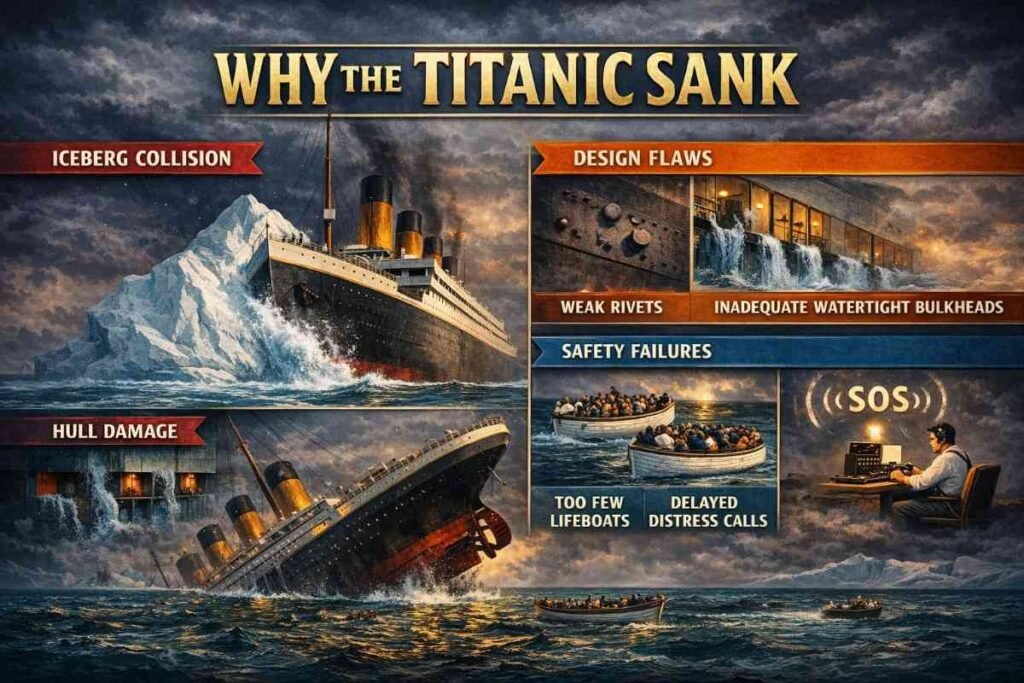
Why the Titanic Sank
1. The Iceberg Collision: The Immediate Cause
On the night of 14 April 1912, Titanic was sailing through the North Atlantic Ocean when it struck an iceberg at approximately 11:40 PM.
Key facts:
- The iceberg did not tear a long gash in the hull.
- Instead, it caused small ruptures and opened seams along the starboard side.
- Six watertight compartments were breached.
Titanic was designed to stay afloat with up to four flooded compartments. Flooding six made sinking inevitable.
2. Fatal Design Flaw: Watertight Compartments Were Not Fully Sealed
Titanic had 16 watertight compartments, promoted as cutting-edge safety technology. However:
- The compartment walls did not extend to the top deck.
- As the bow sank lower, water spilled over from one compartment to the next.
- This created a progressive flooding effect, similar to tipping ice trays.
This design flaw alone ensured that once enough compartments were breached, the ship could not be saved.
3. Weak Rivets and Brittle Steel (Material Failure)
Modern metallurgical studies of Titanic wreckage revealed serious issues:
- Many rivets contained high slag impurities
- In freezing temperatures, these rivets became brittle
- On impact, rivets popped loose, widening the damage
The steel used was also more brittle in cold water compared to modern ship steel, worsening the hull failure.
4. Excessive Speed in Ice-Filled Waters
Despite receiving multiple iceberg warnings throughout the day:
- Titanic continued at nearly 22.5 knots
- This was close to maximum cruising speed
- Officers believed maintaining speed was safe due to Titanic’s size and reputation
This overconfidence reduced reaction time and increased impact damage.
5. Late Iceberg Detection
The iceberg was seen only about 37 seconds before impact due to:
- No binoculars for lookouts
- Extremely calm seas (no wave foam around the iceberg)
- Moonless night conditions
These factors made the iceberg almost invisible until it was too late.
6. The Maneuver That Made Things Worse
When the iceberg was spotted:
- The officer ordered a sharp turn and engine reversal
- Reversing engines reduced steering effectiveness
- The ship scraped the iceberg instead of avoiding it
Many experts believe a head-on collision would have flooded fewer compartments and may not have sunk the ship.
7. Insufficient Lifeboats (Policy Failure)
Titanic carried only 20 lifeboats, enough for about 1,178 people, despite having over 2,200 passengers and crew.
Reasons:
- Maritime laws were outdated
- Regulations were based on ship tonnage, not passenger capacity
- Extra lifeboats were considered unnecessary and unsightly
Even worse, many lifeboats were launched half-empty.
8. Delayed and Inadequate Rescue
- The nearby ship SS Californian did not respond to distress signals
- The RMS Carpathia arrived about 4 hours later
- Most victims died from hypothermia, not drowning
Water temperature was around −2°C (28°F), causing death in minutes.
9. Structural Breakup Before Sinking
As the bow filled with water:
- Extreme stress built up along the hull
- Around 2:18 AM, Titanic broke in two
- The bow and stern sank separately
This was confirmed when the wreck was discovered in 1985.
10. The Real Reason Titanic Sank: A Chain of Failures
The Titanic did not sink because of one mistake, but because of multiple failures happening together:
- Iceberg collision
- Weak rivets and brittle steel
- Poor watertight compartment design
- Excessive speed
- Human overconfidence
- Too few lifeboats
- Delayed rescue
Conclusion
The Titanic disaster reshaped maritime safety forever. It led to:
- Mandatory lifeboats for all passengers
- Continuous radio monitoring
- International ice patrol systems
- Improved ship design standards
The tragedy stands as a lasting lesson that technology without humility and preparation can be deadly.